ESOS thresholds and ESOS qualification criteria at a glance
What ESOS is
The Energy Savings Opportunity Scheme (ESOS) is a mandatory UK energy assessment regime for large organisations.
It operates under the Energy Savings Opportunity Scheme Regulations 2014 (SI 2014/1643), originally enacted to implement Article 8 of the EU Energy Efficiency Directive 2012/27/EU.
ESOS requires qualifying organisations to undertake an energy audit every four years, identifying opportunities for energy efficiency improvements.
It is administered by the Environment Agency in England (EA ESOS guidance) with equivalent administrators in Scotland, Wales, and Northern Ireland.
Policy lead since February 2023 is the Department for Energy Security and Net Zero (DESNZ).
ESOS runs in four-year phases.
Phase 1 ran 2014-2015, Phase 2 ran 2018-2019, Phase 3 ran 2022-2023, and the Phase 4 qualification date is 31 December 2026.
Each phase has its own qualification date, audit period, and compliance deadline.
For what changed this cycle, see ESOS Phase 3 vs Phase 4.
ESOS regulations: the legal instruments behind Phase 4
The ESOS regulations that create the Phase 4 thresholds are the Energy Savings Opportunity Scheme Regulations 2014 (SI 2014/1643), as amended by the ESOS (Amendment) Regulations 2023 (SI 2023/1182).
Two specific provisions do the qualification work: Schedule 1 paragraph 1 (via regulation 15(2)) sets the "large undertaking" thresholds, and regulations 15(1)(b) and 17(2) set the group aggregation rules — regulation 6 designates the compliance bodies (Environment Agency, NRW, SEPA, NIEA), not aggregation.
The Environment Agency (EA ESOS guidance) is the UK scheme administrator for ESOS, and is also the regulator in England (EA ESOS Phase 4 guidance).
Elsewhere the regulator follows the registered office — Natural Resources Wales in Wales, SEPA in Scotland, the Northern Ireland Environment Agency in Northern Ireland, and the Secretary of State for DESNZ for activities carried out wholly or mainly offshore (EA ESOS Phase 4 guidance).
Policy for ESOS sits with the Department for Energy Security and Net Zero (DESNZ), which has held the lead since February 2023 (Environment Agency).
Knowing which regulation underpins a given requirement — Schedule 1 paragraph 1 for qualification, regulations 15(1)(b) and 17(2) for aggregation — helps distinguish what the ESOS regulations legally require from what is best-practice guidance.
ESOS legislation: from the EU Energy Efficiency Directive to UK law
The ESOS legislation originates in Article 8 of the EU Energy Efficiency Directive 2012/27/EU, which required member states to introduce mandatory energy audits for large undertakings.
The UK transposed this obligation into domestic law via the Energy Savings Opportunity Scheme Regulations 2014 (SI 2014/1643).
The original ESOS legislation set the financial thresholds in euros (€50 million turnover, €43 million balance sheet).
SI 2018/1342 re-denominated these into sterling — £44 million turnover and £38 million balance sheet — for qualification dates on or after IP completion day.
The figures have been static since 31 December 2020 and Schedule 1 paragraph 1 has not been amended since; the euro figures are historical only.
The group provisions within the ESOS legislation draw on the Companies Act 2006 sections 1158-1162 definition of parent-subsidiary relationships, applied to UK-incorporated entities only under the group provisions of SI 2014/1643.
ESOS qualification criteria for ESOS Phase Four — 31 December 2026
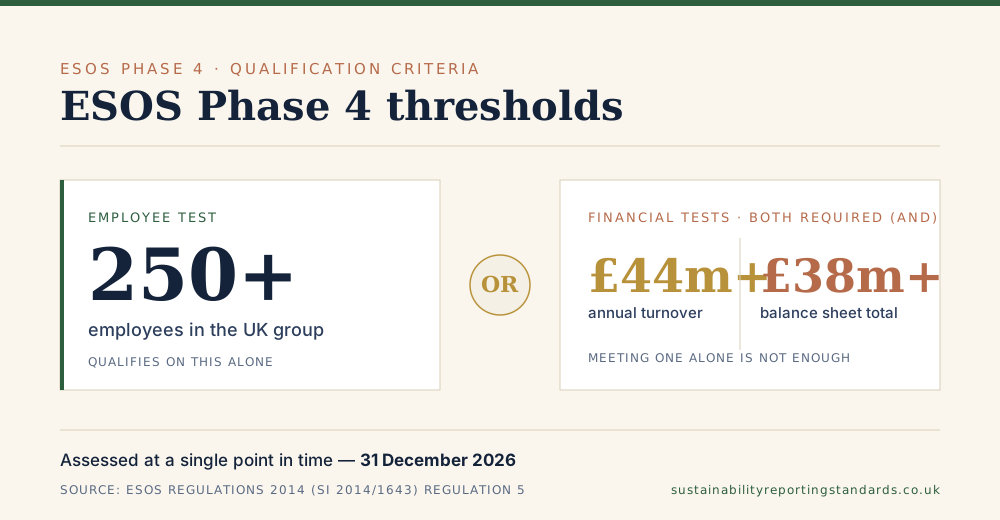
The ESOS qualification criteria for ESOS Phase Four (Phase 4) are assessed at a single point in time: 31 December 2026 (SI 2014/1643 Schedule 1).
An organisation's UK group status on this specific date determines whether it is in scope for the entire Phase 4 cycle, regardless of structural changes before or after.
Understanding the ESOS qualification criteria is essential for compliance planning.
The single-date approach has practical consequences (Schedule 1 paragraph 1):
- Group structure as at 31 December 2026 — acquisitions completed before this date count toward the group; divestments completed before this date are excluded
- Financial figures — most recent accounts period before 31 December 2026 (for a December year-end, accounts for year ending 31 December 2025) [2]
- Employee headcount — UK group total as at 31 December 2026 [2]
- Structural changes made after 31 December 2026 do not change Phase 4 scope, even if they would have changed qualification status [2]
The ESOS Phase 4 compliance date is 5 December 2027 — the notification of compliance is submitted through MESOS with the energy audit complete, and the action plan follows separately by 5 December 2028.
Total energy consumption is measured over a 12-month reference period: 12 consecutive months that include 31 December 2026 and end on or before 5 December 2027 (regulation 22(5)(b)).
If · ListingListed on a UK market?
If · SizeLarge under SECR — 2 of 3?
If · EnergyESOS qualification?
ESOS Phase 4 employee threshold (250+)
The "large undertaking" definition in Schedule 1 paragraph 1 of SI 2014/1643 (via regulation 15(2)) sets the employee threshold at 250 or more.
The 250+ test counts all employees of UK group entities — parent company and all UK-incorporated subsidiaries.
An organisation qualifies on this test alone, regardless of financial position.
The DESNZ ESOS guidance sets out how the headcount is compiled.
The table below summarises what counts — and what is excluded — when measuring the UK group headcount against the 250-employee threshold (DESNZ ESOS guidance).
| Counts toward the 250 employee threshold | Excluded from the count |
|---|---|
| Direct employees of UK group entities — full-time, part-time, fixed-term | Employees of overseas group entities (only UK incorporation counts) |
| Apprentices and trainees on contract | Self-employed contractors and consultants |
| UK group companies and subsidiaries (per group aggregation rules) | Agency workers placed for short periods |
| Workers seconded into the UK group | Dormant relationships — measured on active employment at the qualification date |
For groups straddling the threshold, the qualification date employee count is determinative.
Seasonal businesses must reflect actual headcount at 31 December 2026, not annual average.
ESOS Phase 4 financial thresholds (£44m + £38m)
The "large undertaking" definition in Schedule 1 paragraph 1 of SI 2014/1643 (amounts at paragraph 1A, via regulation 15(2)) sets two sterling financial thresholds that must be met together.
The original euro figures (€50 million turnover, €43 million balance sheet), inherited from the EU Energy Efficiency Directive 2012/27/EU, were re-denominated into pounds by SI 2018/1342 — the sterling figures ARE the legal thresholds, unchanged since 31 December 2020, with no exchange-rate conversion involved:
- Annual turnover (revenue) in excess of £44 million
- Annual balance sheet total in excess of £38 million
Both must be exceeded — meeting only one is insufficient.
An organisation with £100 million turnover but only £30 million balance sheet does NOT qualify on the financial route alone, though it would qualify if it also employs 250+ people via the employee route (Schedule 1 paragraph 1).
The financial figures are drawn from the most recent annual accounts period before the qualification date (SI 2014/1643 Schedule 1).
For a UK group with December year-ends, Phase 4 qualification uses accounts for year ending 31 December 2025 (the last full accounting period before 31 December 2026).
Group aggregation applies — the figures are UK group consolidated totals, not single-entity figures.
This is examined in detail in the next section.
Group Aggregation Requirements
Parent-subsidiary relationships
Companies where another holds >50% voting rights or dominant influence per Companies Act 2006
Common control entities
Multiple entities under the same ultimate parent must be aggregated
UK scope only
Only UK-incorporated entities count for ESOS aggregation; overseas entities excluded
LLPs and limited partnerships
Subject to the same group definitions as companies
Whole group obligation
If ANY entity qualifies, ENTIRE UK group becomes subject to ESOS
ESOS Phase 4 thresholds: group aggregation rules
Regulations 15(1)(b) and 17(2) of SI 2014/1643 set out the group aggregation rules.
The fundamental principle: if ANY single entity in the UK group meets the qualification thresholds at 31 December 2026, the ENTIRE UK group becomes subject to ESOS Phase 4 — including individually sub-threshold entities.
What counts as a group (Companies Act 2006 ss.1158-1162):
- Parent-subsidiary relationships under the Companies Act 2006 sections 1158-1162 definition — companies where another holds more than 50% of voting rights, or has the right to exercise a dominant influence
- Common control — multiple entities under the same ultimate parent
- UK scope only — only UK-incorporated entities count for ESOS aggregation; overseas group entities are excluded
- LLPs and limited partnerships subject to the same group definitions as companies
Where a UK group's only qualifying entity is a small subsidiary that happens to meet the employee or financial thresholds, the obligation extends across all UK entities — including the parent and other subsidiaries that are individually sub-threshold.
Groups should perform consolidated qualification analysis rather than entity-by-entity.
The Responsible Undertaking
Where a group qualifies for ESOS Phase 4, the group provisions of SI 2014/1643 (regulations 15(1)(b) and 17(2)) require the group to designate a single entity as the "Responsible Undertaking" with overall responsibility for ESOS compliance across the UK group.
Notifications are made to the Environment Agency (EA ESOS guidance).
Practical mechanics (DESNZ ESOS guidance):
- Designation flexibility — the group selects which entity serves as Responsible Undertaking; typically the UK parent or holding company
- Group-wide coverage — the Responsible Undertaking must ensure energy audits cover the entire UK group, including individually sub-threshold subsidiaries
- Single compliance notification — one notification submitted to the Environment Agency on behalf of the group
- Legal responsibility — the designated entity bears full legal responsibility for compliance; penalties for non-compliance fall on the Responsible Undertaking
- Change of designation — possible mid-phase but requires notification to the Environment Agency
Acquisitions, divestments, and reorganisations
Structural changes around the qualification date can affect Phase 4 scope, governed by the group aggregation provisions of SI 2014/1643 (regulations 15(1)(b) and 17(2)):
Acquisitions
Companies acquired before 31 December 2026 count toward qualification thresholds (regulations 15(1)(b) and 17(2)).
The acquired entity becomes part of the UK group for ESOS purposes; its employees, turnover, and balance sheet aggregate with the existing group.
The acquired entity's energy consumption must be included in the Phase 4 audit scope.
Historical energy data for the acquired entity may be limited if it was not previously in ESOS scope.
Divestments
Companies sold before 31 December 2026 do not count toward qualification (SI 2014/1643).
They are excluded from employee headcount, turnover, and balance sheet.
If the divested entity continues to be a qualifying undertaking in its own right, it has its own Phase 4 obligations under its new ownership.
Reorganisations
Internal restructuring may change qualification status without changing the underlying business (SI 2014/1643 group aggregation).
Splitting a single qualifying entity into smaller entities may reduce individual entity headcount but does not change UK group aggregation.
Moving entities between UK and overseas group locations affects the UK-only scope of ESOS.
Legal entity structure as at 31 December 2026 is determinative.
Groups planning structural changes around the qualification date should take specific legal advice.
The single-date qualification test means that planning windows close hard on 31 December 2026.
Out-of-scope cases
Certain organisations fall outside the ESOS Phase 4 thresholds entirely and are out of scope under the Energy Savings Opportunity Scheme Regulations 2014.
The categories below sit outside the qualification tests:
Organisations outside the ESOS Phase 4 thresholds
Public sector bodies
Central government, local authorities, NHS trusts and public corporations.
Separate frameworks apply, e.g. the Greening Government Commitments.
Sub-threshold UK groups
Groups not meeting any of the qualification tests at 31 December 2026 — below the employee and both financial thresholds.
Sole traders & partnerships
General partnerships and sole traders have limited legal structure for ESOS obligations, with specific exceptions in the regulations.
Trusts & unincorporated associations
Generally out of scope, though specific cases require individual legal analysis.
Dormant companies
No significant business activity, and hence no meaningful energy consumption to assess.
Overseas-incorporated entities
Only UK-incorporated entities count for ESOS group aggregation; overseas entities are excluded.
Public bodies instead report under frameworks such as the Greening Government Commitments (DESNZ ESOS guidance).
Organisations near the threshold or with unusual structures (mixed public/private group, charity with trading subsidiaries, holding company without operations) should take legal advice on their specific position.
ESOS Phase 4 threshold examples: who qualifies
Applying the ESOS Phase 4 thresholds to real group structures is where qualification decisions are usually won or lost.
The worked examples below show how the employee test, the paired financial tests, and group aggregation combine at the 31 December 2026 qualification date (Schedule 1 paragraph 1).
| Organisation profile | Against the thresholds | Phase 4 outcome |
|---|---|---|
| UK group, 320 employees, £30m turnover, £20m balance sheet | Employee test met (250+); financial tests not met | Qualifies — the employee test qualifies on its own |
| UK company, 90 employees, £60m turnover, £45m balance sheet | Both financial tests met (turnover and balance sheet both in excess of the £44m/£38m thresholds); employee test not met | Qualifies — both financial thresholds are exceeded together |
| UK company, 90 employees, £60m turnover, £20m balance sheet | Only one financial test met; employee test not met | Does not qualify — turnover alone is insufficient on the financial route |
| UK group with a 400-employee subsidiary under a sub-threshold parent | One entity meets the employee test; group aggregation applies | Entire UK group qualifies, including the sub-threshold parent [3] |
| UK parent, 500 UK employees, plus a 2,000-employee overseas subsidiary | Only UK-incorporated headcount counts | Qualifies on UK headcount; overseas employees are excluded |
The recurring theme: the employee test (250+) is a standalone route, the two financial tests only work as a pair, and group aggregation can pull an otherwise sub-threshold parent into scope through a single qualifying subsidiary.
Where a group sits close to any threshold, run the assessment on the projected 31 December 2026 structure rather than today's.
Common ESOS Phase 4 qualification mistakes
Most ESOS Phase 4 qualification errors trace back to a handful of recurring misreadings of the thresholds and the group rules (SI 2014/1643 Schedule 1).
The list below covers the ones Lead Assessors and the Environment Agency see most often.
- Treating the financial tests as either/or — turnover in excess of £44m and balance sheet in excess of £38m must both be met; meeting one is not enough on the financial route [2]
- Assessing single entities instead of the UK group — if any one UK entity qualifies, the whole UK group is in scope, so entity-by-entity checks understate the obligation [3]
- Counting overseas headcount or turnover — only UK-incorporated entities count toward ESOS aggregation; overseas group members are excluded [3]
- Using the wrong accounts period — financial figures come from the most recent accounts before 31 December 2026 (year ending 31 December 2025 for a December year-end), not the current in-progress year [2]
- Assuming a post-date reorganisation changes scope — structural changes after 31 December 2026 do not alter Phase 4 qualification, even if they would have changed the result [2]
- Forgetting the DEC and GDA routes are gone — regulation 26 of SI 2026/701 omits regulation 34 of the 2014 Regulations, so Phase 4 compliance is via an ESOS energy audit or ISO 50001 only; participants who relied on Display Energy Certificates or Green Deal Assessments in earlier phases must switch [14]
Each of these is avoidable with a consolidated, UK-group-level qualification assessment run against the projected 31 December 2026 position.
For the full step-by-step route from qualification to notification, see our ESOS compliance guide.
Seven steps from qualification to compliance
Qualification check
- Assess UK group against three tests
- Aggregate group entities
- Confirm qualification status
Lead assessor engagement
- Identify ESOS Lead Assessor
- Sign engagement agreement
- Define audit scope
Data collection
- Gather 12 months energy data
- Compile site information
- Document energy uses
Energy audit
- 95%+ energy coverage audit
- Site visits as required
- Identify efficiency opportunities
Action plan
- Prioritize opportunities
- Create implementation plan
- Responsible officer sign-off
Compliance notification
- Complete notification template
- Responsible officer sign-off
- Submit to Environment Agency
Record keeping
- Maintain audit evidence
- Submit progress updates — 5 Dec 2029, 2030 and 2031
- Prepare for Phase 5
Compliance routes after meeting ESOS Phase 4 qualification criteria
Meeting the ESOS qualification criteria determines whether ESOS applies.
Compliance — the actual energy assessment and reporting — follows defined routes set out in SI 2014/1643 and updated by SI 2023/1182.
The ISO 50001 certified energy management system is one alternative compliance route.
- ESOS energy audit — undertaken by a lead assessor from an approved register, covering at least 95% of total energy consumption. The default compliance route [13]
- ISO 50001 [8] certified energy management system covering total OR significant (at least 95%) energy consumption — the participant is then deemed to have complied with the duties to appoint a lead assessor, carry out an ESOS energy audit and produce an ESOS report, though a notification of compliance is still required [13]
- Hybrid combinations — where ISO 50001 covers only part of consumption, it exempts only the certified portion; the remainder must be audited and a lead assessor appointed [13]
Display Energy Certificates (DECs) and Green Deal Assessments (GDAs) are not compliance routes in Phase 4 — regulation 26 of SI 2026/701 omits regulation 34 of the 2014 Regulations, the provision that carried them.
The Environment Agency’s stated reason is that they “provide more limited and less tailored recommendations than an ESOS energy audit” (EA ESOS Phase 4 guidance).
Data collected for a DEC or GDA may still feed an ESOS report — an intensity ratio, for instance — but it cannot substitute for the audit (Environment Agency).
Participants relying on these routes in earlier phases must move to an ESOS energy audit or ISO 50001 for Phase 4.
The ESOS (Amendment) Regulations 2023 (SI 2023/1182) introduced significant Phase 3 enhancements that carry into Phase 4: energy intensity ratios, Action Plan submission requirement, mid-phase Progress Updates, and enhanced site-level reporting.
Phase 4 entrants should plan for full implementation of these enhanced requirements.
Total energy consumption is measured over a 12-month reference period — 12 consecutive months that include the qualification date of 31 December 2026 and end on or before the compliance date of 5 December 2027 (regulation 22(5)(b)).
Verifiable data must be used where it is reasonably practicable to do so (EA ESOS Phase 4 guidance).
ESOS Phase 4 requirements: energy audits, action plans and changes from Phase 3
Once an organisation qualifies, the ESOS Phase 4 requirements are to measure total energy consumption, audit at least 95% of it, produce an action plan confirmed by the responsible officer, and notify the Environment Agency before 5 December 2027.
Phase 4 carries forward the enhancements first introduced mid-cycle by the ESOS (Amendment) Regulations 2023.
Energy audit requirements
The ESOS energy audit must cover 95% of the organisation's total energy consumption across all energy types — electricity, gas, transport fuels, and other sources (DESNZ ESOS guidance).
The 5% de minimis allowance lets minor uses be excluded where auditing them would be disproportionate.
Audits are conducted by a registered Lead Assessor using at least 12 months of consumption data, and must identify energy-efficiency opportunities with cost-benefit analysis and estimated payback (DESNZ).
Action plans and progress updates
The action plan requirement was introduced for Phase 3 by Part 6A of SI 2023/1182, and it carries into Phase 4.
Every qualifying organisation must set out the energy-efficiency measures it intends to take and obtain sign-off from one or more directors, or equivalent (EA ESOS Phase 4 guidance).
The Phase 4 action plan is due by 5 December 2028 and covers 6 December 2027 to 5 December 2031.
Three progress updates follow — 5 December 2029, 5 December 2030 and 5 December 2031 — the third being new for Phase 4 under regulation 28 of SI 2026/701.
Deadlines, sign-off, and publication are covered in our ESOS action plan guide.
What changed from Phase 3
- Display Energy Certificates (DECs) and Green Deal Assessments (GDAs) are removed as compliance routes — only the ESOS audit or ISO 50001 remain (SI 2026/701 regulation 26)
- The ESOS report and notification must state the energy savings actually achieved in the compliance period, measure by measure in kWh, with a saving category for each; only the combined figure is published [13]
- The notification must include an action plan review — proposed measures from the previous action plan that were not implemented, and why [13]
- A third progress update is added, due 5 December 2031 under regulation 28 of SI 2026/701 [14]
- New regulation 33A — an organisation with zero energy consumption need not carry out an assessment or appoint a lead assessor, but must still notify [14]
- No lead assessor is required where total energy consumption is below 40,000 kWh, or where ISO 50001 covers total or significant consumption [13]
- The insolvency exclusion is widened — undertakings in insolvency proceedings at any point between the qualification date and the compliance date are excluded [14]
- Mandatory action plans with sign-off, and mid-phase progress updates, were Phase 3 changes under Part 6A of SI 2023/1182 rather than Phase 4 ones, and carry forward [4]
- The 95% audit coverage threshold (5% de minimis) also came in for Phase 3, via SI 2023/1182 — it is not new in Phase 4 [4]
- Mandatory net-zero requirements remain deferred to Phase 5 (2027–2031) [14]
New in ESOS Phase Four: what SI 2026/701 adds
The Phase 4 guidance published on 30 July 2026 sets out three genuinely new duties, on top of the removal of the DEC and GDA routes.
All three come from the Energy Savings Opportunity Scheme (Amendment) Regulations 2026, in force since 22 July 2026.
Report the savings you actually achieved
The ESOS report and the notification of compliance must state the energy savings achieved during the compliance period (EA ESOS Phase 4 guidance).
That means the measures implemented, the saving from each measure in kWh, and each measure’s energy-saving category (Environment Agency).
Only the combined figure across all measures is published — per-measure savings are withheld as potentially commercially sensitive (EA ESOS Phase 4 guidance).
The action plan review
The ESOS report and notification of compliance must identify the proposed measures from the previous action plan that were not implemented, and explain why (EA ESOS Phase 4 guidance).
These submissions are not published; action plans and progress updates are (Environment Agency).
A third progress update
Phase 4 has three progress updates, not two — 5 December 2029, 5 December 2030 and 5 December 2031 (EA ESOS Phase 4 guidance).
The final one is added by regulation 28 of SI 2026/701, which amends regulation 34B to require a final progress update for compliance periods ending on or after 5 December 2027.
Other changes worth knowing
- New regulation 33A — an organisation with zero energy consumption need not carry out an ESOS assessment or appoint a lead assessor, but must still submit a notification of compliance [14]
- No lead assessor is required where total energy consumption is below 40,000 kWh, or where ISO 50001 covers total or significant consumption [13]
- The insolvency exclusion is widened — undertakings in insolvency proceedings at any point between the qualification date and the compliance date are excluded, as are group undertakings of an insolvent large undertaking unless another large undertaking in the group is solvent [14]
- The qualification thresholds are unchanged; ESOS/SECR threshold alignment remains deferred to Phase 5 [14]
ESOS requirements checklist: what qualifying organisations must do
Once an organisation meets the ESOS Phase 4 thresholds, the ESOS requirements are the same regardless of which qualification route applied.
The checklist below draws together the obligations covered in detail earlier in this guide.
- Notify your regulator of compliance through MESOS by 5 December 2027 [13]
- Complete an energy audit covering at least 95% of total energy consumption, or hold an ISO 50001 certified energy management system covering total or significant consumption [13]
- Measure total energy consumption over a 12-month reference period that includes 31 December 2026 and ends on or before 5 December 2027 [13]
- State the energy savings actually achieved in the compliance period — measures implemented, kWh saved per measure, and each measure's saving category [13]
- Include an action plan review in the notification: proposed measures from the previous action plan that were not implemented, and why [13]
- Produce a director-approved action plan by 5 December 2028, covering 6 December 2027 to 5 December 2031 [13]
- Submit three progress updates — 5 December 2029, 5 December 2030 and 5 December 2031 [13]
- Designate a single Responsible Undertaking with group-wide compliance responsibility [3]
- Maintain compliance records — failure to do so risks a civil penalty of up to £5,000 [6]
These ESOS requirements apply across the whole UK group once any single entity qualifies (regulations 15(1)(b) and 17(2)) — see group aggregation above.
For the full step-by-step compliance pathway, see our ESOS compliance guide.
Penalties for non-compliance
The Environment Agency enforces ESOS in England (EA ESOS guidance) with equivalent enforcement bodies in devolved nations.
Penalties for missing the ESOS Phase 4 requirements can be substantial, as set out in the EA Enforcement and Sanctions Policy:
- Failure to undertake an energy audit (regulation 45) — civil penalty of £50,000, with downward discretion, plus £500 for each working day after service of the compliance notice until it is remedied, capped at 80 working days, plus publication [13]
- Failure to notify (regulation 43) — civil penalty up to £5,000, plus £500 for each working day after service of the penalty notice until notification is completed, capped at 80 working days, plus publication [13]
- Failure to maintain records (regulation 44) — civil penalty up to £5,000 plus the compliance body's cost of auditing the activity, plus publication [13]
- Failure to comply with a compliance, enforcement or penalty notice (regulation 46) — up to £5,000 plus £500 for each working day, capped at 80 working days, plus publication [13]
- False or misleading statement (regulation 47) — £50,000, with downward discretion, plus publication [13]
- Publication — the regulator names the person penalised, the requirement breached and the amount [13]
The Environment Agency publishes annual ESOS compliance statistics.
Phase 3 enforcement actions established that the EA exercises its penalty powers, including against well-known organisations.
Audit committees should treat ESOS compliance as a reputational risk alongside the financial penalty exposure.
For the full penalty framework — audit failure, notification failure, and daily penalties — see our ESOS penalties and enforcement guide.
ESOS deadlines: qualification, notification and action plan dates
The ESOS Phase 4 deadlines fall into three groups: the qualification assessment date, the compliance and notification deadline, and the ongoing action plan reporting cadence.
| Deadline | Date | What's due |
|---|---|---|
| Phase 4 compliance period | 6 Dec 2023 – 5 Dec 2027 | The four-year cycle the Phase 4 assessment covers [13] |
| Phase 4 qualification date | 31 Dec 2026 | UK group status assessed against the three tests [2] |
| Phase 4 compliance date | 5 Dec 2027 | Notification of compliance submitted through MESOS, energy audit complete [13] |
| Action plan | 5 Dec 2028 | Action plan confirmed by the responsible officer, covering 6 Dec 2027 to 5 Dec 2031 [13] |
| First progress update | 5 Dec 2029 | Progress against the action plan [13] |
| Second progress update | 5 Dec 2030 | Progress against the action plan [13] |
| Third progress update | 5 Dec 2031 | Final update — new in Phase 4, under regulation 28 of SI 2026/701 [14] |
| Phase 5 | 2027–2031 | Next ESOS cycle; mandatory net-zero requirements postponed to this phase [14] |
Missing the audit or the notification carries a civil penalty risk — £50,000, with downward discretion, plus £500 for each working day for a missed energy audit, and up to £5,000 plus £500 for each working day for a missed notification, each capped at 80 working days (EA ESOS Phase 4 guidance).
A missed action plan or progress update carries no direct penalty in Part 8; the Scheme Administrator publishes the failure instead, though an enforcement notice under regulation 46(1) demanding one is separately enforceable under regulation 46.
See penalties above for the full enforcement framework.
ESOS vs UK SRS: Key Differences
Legal basis
ESOS: SI 2014/1643 under DESNZ | UK SRS: FCA listing rules and Companies Act 2006
Scope determinant
ESOS: Size thresholds (250+ employees or financial tests) | UK SRS: Listing status (UKLR categories)
Content focus
ESOS: Operational energy audit with efficiency opportunities | UK SRS: Investor-facing climate disclosures
Primary audience
ESOS: Environment Agency and management | UK SRS: Investors and lenders
Data overlap
Both use Scope 1 and 2 emissions data, but analytical depth and presentation differ
How ESOS sits alongside UK SRS
The Energy Savings Opportunity Scheme Regulations 2014 and the UK Sustainability Reporting Standards are separate regulatory regimes that may apply concurrently to the same organisation.
The two are distinct in legal basis, scope, content, and audience — as summarised below.
| Dimension | ESOS | UK SRS |
|---|---|---|
| Legal basis | Energy Savings Opportunity Scheme Regulations 2014 (SI 2014/1643) under DESNZ policy lead | Published by DBT on 25 February 2026 under FCA listing rules and the Companies Act 2006 framework |
| Scope determinant | Group size — 250+ employees, OR £44m turnover AND £38m balance sheet | Listing status (FCA CP26/5 for UKLR 6, 14, 15, 16, 22); private extension awaiting MCR consultation |
| Content | Operational energy audit identifying efficiency opportunities, with quantified savings potential | Investor-facing disclosures across four pillars, with Scope 1, 2 and 3 emissions |
| Primary audience | Environment Agency notification; senior management responsible for energy action | Investors, lenders and other creditors; audit committee oversight |
Many large UK organisations will be subject to both — a UK-listed company with 250+ employees may need both ESOS Phase 4 compliance and UK SRS S2 reporting.
The data infrastructure overlap (Scope 1 and 2 emissions, energy use by site) supports both regimes; the analytical depth and audience differ substantially.
SECR (Streamlined Energy and Carbon Reporting, SI 2018/1155) is a third regime that also operates alongside both ESOS and UK SRS.
For integrated compliance across all three regimes, see our integrated ESOS, SECR and UK SRS compliance guide.
Frequently asked questions
When is the ESOS Phase 4 qualification date?
ESOS Phase 4 qualification is assessed at a single point in time: 31 December 2026 [2].
An organisation's UK group status on this specific date determines whether it is in scope for the entire Phase 4 cycle.
What are the three ESOS qualification thresholds?
Per the "large undertaking" definition in Schedule 1 paragraph 1 of SI 2014/1643, amounts at paragraph 1A, reached via regulation 15(2) [2]: (1) employee test — 250 or more employees in the group; or (2) and (3) financial tests — annual turnover in excess of £44m AND annual balance sheet total in excess of £38m (both must be met together; the figures have been in sterling since being converted from euro by SI 2018/1342 and unchanged since 31 December 2020).
Meeting only one financial test is insufficient.
Does meeting just the turnover test qualify me for ESOS?
No. The two financial tests work together — both turnover in excess of £44m AND balance sheet in excess of £38m must be met.
Meeting only one financial test is not sufficient on the financial route.
The employee test (250+) qualifies on its own [2].
How do group aggregation rules work?
Per regulations 15(1)(b) and 17(2) of SI 2014/1643 [3]: if ANY single entity in the UK group meets the qualification thresholds, the ENTIRE UK group becomes subject to ESOS — including individually sub-threshold entities.
Group definition uses Companies Act 2006 sections 1158-1162 [7].
Only UK-incorporated entities count; overseas entities are excluded.
What about acquisitions or divestments before the qualification date?
Companies acquired before 31 December 2026 count toward qualification thresholds and must be included in the Phase 4 audit scope [3].
Companies sold before 31 December 2026 do not count toward qualification and are excluded.
Internal reorganisations may change qualification without changing the underlying business — groups planning structural changes around the qualification date should take legal advice.
When is the Phase 4 compliance deadline?
The Phase 4 compliance date is 5 December 2027 [13].
By that date, qualifying organisations must have completed the energy audit and submitted a notification of compliance through MESOS.
The action plan is a separate submission, due by 5 December 2028 [13].
Total energy consumption is measured over a 12-month reference period — 12 consecutive months that include 31 December 2026 and end on or before 5 December 2027 [13].
What are the penalties for non-compliance?
Per SI 2014/1643 Part 8, regulations 43–47 [13]: failure to undertake an energy audit (regulation 45) attracts a civil penalty of £50,000, with downward discretion, plus £500 for each working day after service of the compliance notice until it is remedied, capped at 80 working days.
Failure to notify (regulation 43) attracts up to £5,000 plus £500 for each working day, capped at 80 working days.
Failure to maintain records (regulation 44) attracts up to £5,000 plus the compliance body's cost of auditing the activity, and a false or misleading statement (regulation 47) carries £50,000, with downward discretion.
Every penalty is published — the regulator names the person penalised, the requirement breached and the amount.
There is no direct penalty in Part 8 for failing to submit an action plan or a progress update; the Scheme Administrator publishes the failure instead, though an enforcement notice served under regulation 46(1) demanding one is separately enforceable under regulation 46 [13].
Has the ESOS Phase 4 guidance been published?
Yes.
The Environment Agency published "Comply with the Energy Savings Opportunity Scheme (ESOS) phase 4" on 30 July 2026 [13].
It implements the Energy Savings Opportunity Scheme (Amendment) Regulations 2026 (SI 2026/701), made on 23 June 2026, laid before Parliament on 1 July 2026 and in force from 22 July 2026 [14].
Does ISO 50001 have to cover 100% of energy consumption?
No. Where ISO 50001 certification covers a participant's total OR significant energy consumption — significant being the areas comprising at least 95% of the total — the participant is deemed to have complied with the duties to appoint a lead assessor, carry out an ESOS energy audit and produce an ESOS report [13].
A notification of compliance is still required.
Where certification covers only part of consumption, the exemption applies only to the certified portion; the remainder must be audited and a lead assessor appointed [13].
How many progress updates does ESOS Phase 4 require?
Three.
Progress updates on the Phase 4 action plan are due on 5 December 2029, 5 December 2030 and 5 December 2031 [13].
The third is new for Phase 4 — regulation 28 of SI 2026/701 amends regulation 34B to require a final progress update for compliance periods ending on or after 5 December 2027 [14].
What must an ESOS Phase 4 report say about savings already achieved?
New for Phase 4, the ESOS report and notification of compliance must state the energy savings achieved during the compliance period: the measures implemented, the saving from each measure in kWh, and each measure's energy-saving category [13].
Only the combined saving across all measures is published; per-measure savings are withheld as potentially commercially sensitive [13].
Does ESOS replace or align with UK SRS?
Neither — ESOS and UK SRS are separate regulatory regimes.
ESOS [1] is an energy assessment regime under SI 2014/1643 with operational focus; UK SRS [10] is an investor-facing sustainability disclosure regime under FCA CP26/5 with investor focus.
An organisation may be subject to one, both, or neither.
Many large UK organisations will be subject to both, with data infrastructure overlap on Scope 1 and 2 emissions.